
Strong legs form the foundation of almost every workout. Whether you want to get fitter, build muscle mass, improve your athletic performance, or simply navigate daily life with more strength, well-developed leg muscles make a big difference. Yet many people think that an effective leg workout depends on a gym full of large machines. Fortunately, that has long since ceased to be the case.
With the right approach and suitable equipment, you can achieve excellent results at home. More and more people are therefore choosing their own Home Gym, allowing them to train whenever it suits them, without travel time or crowded gyms. From a simple workout bench to an extensive Power Station or a multifunctional Smith Machine, there are countless ways to train your legs effectively at home these days.
In this guide, you will discover how to optimally develop your leg muscles without a gym, which exercises are the most effective, and which equipment will help you reach your goals faster.
Why strong leg muscles are important
Many athletes focus primarily on their chest, arms, and shoulders. Yet the legs make up the largest muscle group in the body. Strong legs contribute to:
• More strength in daily movements
• Better athletic performance
• Improved stability and balance
• Higher calorie burn
• Support for joints
• Reduction of injury risks
When your legs get stronger, your entire body benefits. That is why it is important to regularly focus on your quadriceps, hamstrings, glutes, and calves.
Can you really train your legs effectively at home?
A frequently asked question is whether training at home can be just as effective as training in a gym. The answer is simple: yes.
The effectiveness of a workout is not determined by the location, but by factors such as:
• Training intensity
• Consistency
• Progressive overload
• Correct execution
• Suitable equipment
With a well-equipped Home Gym, you can perform almost all the important leg exercises you would do in a gym.
The most important muscle groups in the legs
Before you start training, it is helpful to know which muscles you want to develop.
Quadriceps
The quadriceps are located on the front of the upper leg. These muscles are responsible for extending the knee and play an important role in squats, lunges, and jumps.
Hamstrings
The hamstrings are located on the back of the upper leg. They help with flexing the knee and support explosive movements.
Glutes
Strong glutes provide more strength, stability, and better posture. They are activated during almost every leg exercise.
Calves
The calf muscles support walking, running, jumping, and daily movements.
Effective leg exercises without a gym
You don't always need heavy machines to get results. Many exercises can be performed at home with limited equipment.
Squats
The squat is often considered the king of all leg exercises.
Benefits:
• Activates multiple muscle groups simultaneously
• Improves strength and stability
• Suitable for beginners and advanced athletes
For extra resistance, you can use a Smith Machine, a Squat rack, or free weights.
Lunges
Lunges are ideal for improving strength, balance, and coordination.
Variations:
• Walking lunges
• Reverse lunges
• Bulgarian split squats
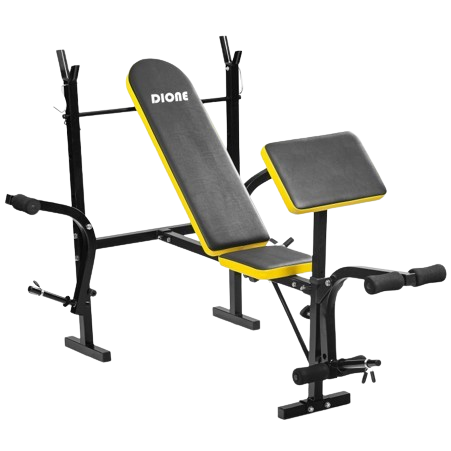
These exercises are excellently performed with a Weight Bench or workout bench for support.
Step-ups
Step-ups train the quadriceps, glutes, and hamstrings at the same time. A sturdy bench or platform is enough to perform this exercise.
Calf Raises
For strong calves, calf raises are an excellent choice. These can be performed with body weight or with additional resistance.
Which equipment helps with leg training?
Although body weight exercises are effective, equipment can help you make progress faster.
Leg trainer
A leg trainer is specifically designed to strengthen the leg muscles in a targeted way. This type of equipment makes it possible to train in a controlled manner and give specific muscle groups extra attention.

For many home athletes, a leg trainer is a valuable addition to their training space.
Leg Press
A Leg Press is among the most popular exercises for training the legs.
Benefits:
• High training load possible
• Less pressure on the lower back
• Suitable for muscle building
Not everyone has room for a separate leg press, but many modern Power Stations offer similar training possibilities.
Smith Machine
A Smith Machine provides extra safety during heavy squats and other leg exercises.
Benefits:
• Controlled range of motion
• Suitable for beginners
• Train safely without a training partner
• Ideal for progressive strength training
For many home athletes, a Smith Machine is one of the most versatile investments for a Home Gym.
Squat rack
A Squat rack gives maximum freedom during squats, lunges, and other compound exercises.
The great advantage is that you can perform natural movements while training safely at the same time.
Power Station
A Power Station combines multiple training possibilities into one piece of equipment.
With a high-quality Power Station, you can, among other things:
• Perform leg extensions
• Train hamstrings
• Do squats
• Perform full-body strength training
For those looking to use available space efficiently, modern Power Stations are often an excellent solution.
Why a complete Home Gym offers benefits
Many people start with free weights and later discover that a complete Home Gym offers more possibilities.
Benefits of training at home:
• No travel time
• Always available
• Train at your own pace
• More privacy
• Long-term training solution
By cleverly combining multiple pieces of equipment, you create a training environment where almost all muscle groups can be trained effectively.
The role of a Lat tower in strength training
Although a Lat tower is primarily known for back training, it also plays a role in a complete training routine.
Strong back muscles support heavy leg exercises like squats and deadlifts. This results in better posture and more stability during training.
Cable exercises for stability and strength
Many athletes associate a Cable Crossover exclusively with chest training, but cable systems can also be valuable for the legs.
With a Cable Crossover, various functional exercises can be performed that contribute to:
• More stability
• Improved balance
• Better muscle control
• Extra variety within the workout
For smaller training spaces, a wall-mounted Cable Crossover can be a smart solution.
Training schedule for strong legs at home
A simple training routine can look like this:
Workout A
• Squats
• Lunges
• Calf Raises
• Step-ups
Workout B
• Bulgarian Split Squats
• Leg Press alternative
• Romanian Deadlifts
• Wall Sit
Train two to three times a week and gradually increase the resistance to keep making progress.
Common mistakes when training legs
Too little training volume
Many athletes train their legs less frequently than their upper body.
Insufficient depth during squats
A limited range of motion reduces the effectiveness of the exercise.
No progressive overload
Without extra resistance or heavier workouts, muscle growth will eventually stagnate.
Neglecting recovery
Muscles grow during recovery. Sufficient rest is therefore essential.
How to choose the right equipment for your goals?
The ideal choice depends on your training goals, available space, and experience.
When you are primarily focused on muscle building and versatility, a Power Station, Smith Machine, or Squat rack can be excellent options.
For athletes who want to create a complete training environment, a well-equipped Home Gym offers the most possibilities.
At StrayShop, sports enthusiasts will find various solutions for effective at-home training, from strength equipment to multifunctional training stations suitable for both beginners and advanced users.
Conclusion
Training your leg muscles does not have to depend on a gym. With the right exercises, sufficient consistency, and suitable equipment, you can achieve impressive results at home.
Whether you choose a simple workout setup or an extensive Home Gym with a Power Station, Smith Machine, Squat rack, Leg Trainer, or other fitness equipment, the most important thing is that you build a training routine that you can sustain for the long term.
By training smartly and becoming stronger step by step, you can build powerful, functional, and well-developed leg muscles from home.
Frequently asked questions
Can you build strong leg muscles without a gym?
Yes. With consistent training, progressive overload, and the right equipment, you can achieve excellent results at home.
Which exercise is best for the legs at home?
Squats are among the most effective exercises because they activate multiple muscle groups simultaneously.
Is a Smith Machine suitable for leg training?
Yes. A Smith Machine provides extra safety and support during squats and other leg exercises.
What is the benefit of a Power Station for home?
A Power Station combines multiple training possibilities into one machine and helps utilize space efficiently.
Do I need a Leg Press for strong legs?
No. Many exercises like squats, lunges, and split squats can yield similar results.
How often should I train my legs?
For most athletes, two to three workouts per week are sufficient to build strength and muscle mass.
Is a Squat rack better than a Smith Machine?
That depends on your experience and goals. A Squat rack offers more freedom of movement, while a Smith Machine provides extra stability and safety.
Which equipment is suitable for a small Home Gym?
Compact solutions like a wall-mounted Cable Crossover, workout bench, or multifunctional power station are often suitable for limited spaces.