
More and more Dutch people are choosing to train at home. A private home gym offers flexibility, privacy, and the opportunity to work on your fitness and strength whenever you want. However, many people think you need a large garage, basement, or separate fitness room to create an effective training environment. In reality, you can put together a complete home gym even with limited space.
Whether you have a spare room, attic, corner of the living room, or a small garage available, you can make the most of every square meter with the right choices. In this guide, you will discover how to set up a functional home gym, which equipment is most suitable for small spaces, and what you need to look out for when making smart choices.
Why choose a home gym in a small space?
Many people search online for questions such as:
• How do I create a home gym in a small room?
• Which fitness equipment takes up little space?
• What do I really need for training at home?
• How do I efficiently furnish a compact fitness space?
These questions are logical. The average home does not always offer a lot of extra space. However, limited space does not have to be a barrier to effective workouts.
A well-designed home gym helps you train consistently without the travel time to the gym. In addition, you can fully adapt the space to your training goals, whether you want to build muscle mass, get fitter, or improve your overall health.
Start with a clear training goal
Before purchasing equipment, it is important to determine what you want to achieve.
Ask yourself:
• Do I want to build muscle mass?
• Do I want to get stronger?
• Am I looking for a complete full-body workout?
• Do I train mainly for fitness or strength?
The answer determines which equipment is most suitable.
For strength training, the focus is often on a weight bench, squat rack, Smith machine, or a compact multi-gym. For versatile training, systems with cables, such as a cable crossover, can be an excellent solution.
Measure the available space accurately
One of the most common mistakes when setting up a home gym is underestimating the required space for movement.
Don't just measure the floor area, but also take into account:
• Ceiling height
• Freedom of movement around the equipment
• Storage space for accessories
• Opening space of doors and windows
By creating a floor plan in advance, you prevent equipment from being impractical to use later.
Choose multi-functional fitness equipment
When space is limited, multi-functional fitness equipment provides the most value.
Instead of several separate machines, it is better to choose equipment that supports various exercises.
A compact multi-gym, for example, offers options for:
• Chest training
• Back training
• Shoulder exercises
• Arm training
• Leg exercises
This allows you to replace several individual machines with one efficient system.
Many modern multi-gyms are specially designed for home use and combine a compact size with extensive training possibilities.
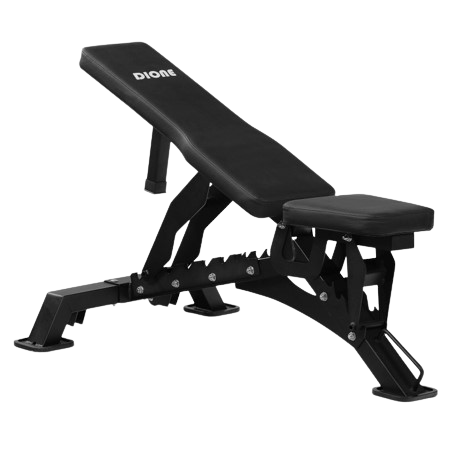
An adjustable weight bench as the foundation of your home gym
A high-quality weight bench is one of the most versatile components of a home gym.
With an adjustable workout bench, you can perform exercises including:
• Bench press
• Shoulder press
• Dumbbell exercises
• Core training
• Back exercises
Because the backrest is adjustable, you can effectively train different muscle groups without adding extra equipment.
For many users, a combination of a workout bench and a compact strength system forms the ideal basis for a small fitness room.
Why a multi-gym is ideal for limited spaces
A separate squat rack, cable system, pulley station, and other machines often take up a lot of space.
A well-designed multi-gym combines multiple training functions into one device.
This makes a multi-gym attractive for:
• Beginners
• Advanced athletes
• Families with multiple users
• People with limited space
At StrayShop, many customers choose compact solutions that allow for a full-body workout without overcrowding the space.
Cable crossover systems for versatile training
One of the most popular developments in home fitness is the cable crossover.
Cable training offers a natural range of motion and supports dozens of exercises for:
• Chest
• Back
• Shoulders
• Arms
• Core
For small spaces, a wall-mounted cable crossover can be particularly interesting. Because the system is attached to the wall, the floor remains largely clear.
This allows you to combine training capabilities with an efficient layout of the available space.

Is a Smith machine suitable for a small home gym?
Many athletes wonder if a Smith machine is too big for home use.
Modern models are often more compact than many people realize. Moreover, some versions combine multiple functions, including:
• Guided bench press
• Squats
• Pull-ups
• Cable training
For users looking for maximum training possibilities within a limited space, a multi-functional Smith machine can be a smart investment.
A lat tower for effective back training
Back training is often forgotten when putting together a home gym.
A lat tower offers options for exercises such as:
• Lat pulldowns
• Seated rows
• Tricep pushdowns
For athletes who are serious about building muscle, a lat tower is a valuable addition to a compact training area.
Do you need a leg press in a small space?
The leg press is popular for leg training, but it usually takes up a relatively large amount of space.
When available space is limited, many athletes opt for alternatives such as:
• Squats
• Lunges
• Bulgarian split squats
• Step-ups
If you have enough space, a compact leg press can be an excellent addition. In smaller rooms, however, it is often wiser to choose multi-functional equipment that preserves more training options.
Smart integration of a squat rack in your home gym
A squat rack remains one of the most effective tools for strength training.
Many modern racks feature:
• Safety arms
• Storage options
• Pull-up stations
• Compact design
This allows you to train safely without the rack dominating the entire space.
For serious strength training, a squat rack often forms the centerpiece of the home gym.
Consider storage and organization
A small space quickly feels cluttered when weights and accessories are everywhere.
Therefore, use:
• Wall racks
• Storage pins for weight plates
• Dumbbell stands
• Storage bins for accessories
An organized training space not only looks better but also motivates you to train regularly.
Make smart use of vertical space
Many people only look at floor space, while the walls often remain unused.
Vertical storage can save space for:
• Weight plates
• Resistance bands
• Training accessories
Systems such as a wall-mounted cable crossover also benefit from this approach.
Lighting and ventilation make a big difference
A pleasant training environment contributes to motivation and performance.
Therefore, ensure:
• Sufficient daylight
• Good ventilation
• Bright lighting
• A tidy appearance
Even a small room feels larger when it is well furnished.
Why quality is more important than quantity
A common mistake is buying too much equipment.
Instead of ten different machines, it is often smarter to invest in a few high-quality devices that will last for years.
A combination of, for example, a weight bench, multi-gym, and a compact cable crossover often offers more training possibilities than a room full of individual machines.
More than fitness: multi-functional use of the space
Many households use the same room for multiple purposes.
That is why some people choose, in addition to their fitness area, recreational products such as a pool table, foosball table, table tennis table, pool tables, foosball tables, or table tennis tables.
When you have enough space, such additions can provide extra relaxation and family fun. For smaller spaces, however, it remains wise to first prioritize the equipment that directly contributes to your training goals.
Conclusion
A small space does not have to be a limitation for an effective home gym. With the right planning and smart choices, you can turn almost any room into a functional training environment.
By choosing multi-functional solutions such as a multi-gym, weight bench, cable crossover, Smith machine, lat tower, or compact squat rack, you can make optimal use of the available space without compromising on training possibilities.
At StrayShop, you will find various solutions for athletes who want to create an efficient home gym. By focusing on quality, functionality, and space-saving, you can build a training environment in which you can continue to work on your fitness goals with pleasure for years to come.
Frequently asked questions
1. How big does a home gym need to be at a minimum?
A home gym does not have to be large. With a smart layout, you can already train effectively in a small room, attic space, or garage corner.
2. Which fitness equipment is most suitable for small spaces?
Multi-functional solutions such as a multi-gym, adjustable weight bench, and a wall-mounted cable crossover are often ideal for limited spaces.
3. Is a Smith machine suitable for home use?
Yes. Many modern models combine multiple training functions and are specifically designed for home use.
4. What is better for a small home gym: a squat rack or a multi-gym?
That depends on your training goals. A squat rack is ideal for free strength training, while a multi-gym combines more exercises into one machine.
5. Can I train my legs effectively without a leg press?
Yes. Exercises such as squats, lunges, and split squats are excellent alternatives to a leg press and often require less space.