
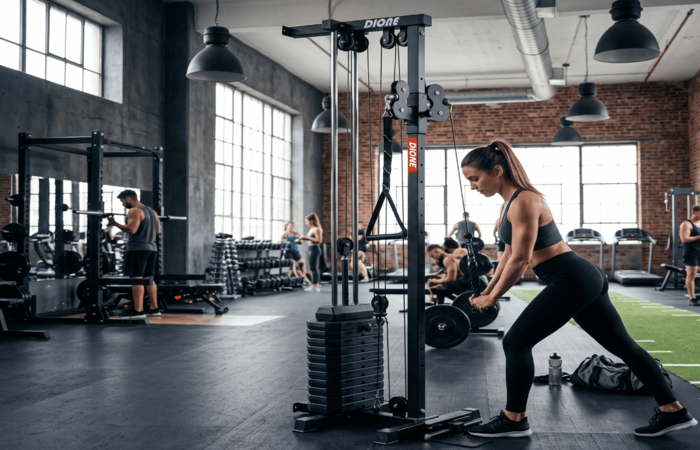
A good back workout doesn't have to be complicated. With a lat tower you can do many exercises, right at home. But did you know that the height of the pulley makes a big difference? A high pulley and a low pulley each have their own function. One is useful for your back, while the other works particularly well for your arms, shoulders and rowing movements.
Yet many athletes don't know which pulley they can use best. And that's understandable. At first glance they look very similar.
In this blog we explain what the difference is between a high and low pulley, which muscles you train with it and which system suits your goals. We also look at some fitness devices from StrayShop that you can use for a versatile workout at home.
What is a lat tower and how does a pulley work?
A lat tower is a fitness device with which you train with cables and weights. You pull on a handle. The cable runs through a pulley, also known as a pulley. This way, the weight moves with your movement.
You can set the resistance yourself. This makes the device suitable for both beginners and experienced athletes.
A lat tower often has a high pulley, a low pulley or both. With some devices you can use different handles. This way you can train multiple muscle groups with one device.
The nice thing is that you don't always have to pick up different weights. You set the weight and get to work. Simple!
What is a high pulley?
A high pulley is located at the top of the device. You usually pull the cable from top to bottom. This makes it ideal for exercises where you use your back and arms.
The best-known exercise is the lat pulldown. Here you pull a bar from a high position to your chest. You mainly train the latissimus dorsi, also known as the lat muscle.
What exercises can you do with a high pulley?
With a high pulley you can do more than just train your back.
- Lat pulldown: pull the bar to your chest to train your lat muscles.
- Triceps pushdown: push a handle down to train your triceps.
- Face pull: pull a rope towards your face to train the muscles around your shoulders and upper back.
- Straight arm pulldown: pull the cable down with almost straight arms to engage your back muscles.
You see it: one pulley already offers many possibilities.
When do you choose a high pulley?
A high pulley is a good choice if you want to pay more attention to your back and triceps. It is also useful if you want to include the lat pulldown in your training schedule.
Do you want to build a wider and stronger back? Then this is a great part of your workout.
Pay attention to your posture. Do not jerk the cable. Keep your back stable and move slowly. This way you keep the exercise well under control.
What is a low pulley?
A low pulley is located at the bottom of the device. Here you usually pull the cable from bottom to top or towards your body.
This position is especially useful for rowing exercises. You sit or stand in front of the device and pull the handle towards your torso.
The low pulley is not only suitable for your back. You can also use it to train your biceps and shoulders.
What exercises can you do with a low pulley?
With the low pulley you also have a lot of choice.
- Seated cable row: pull the handle towards your stomach to train your back and biceps.
- Biceps curl: pull the cable up with your elbows close to your body.
- Upright row: pull the cable up along your body to engage your shoulders and upper back.
- Cable lateral raise: move your arm sideways to train your shoulders.
The low pulley is therefore a great choice for athletes who want to vary their workout.
When do you choose a low pulley?
Do you want to do more rowing movements? Or do you want to pay extra attention to your biceps and shoulders? Then a low pulley is very useful.
Also for athletes who like to train different muscle groups with one device, this is a good option.
High or low pulley: which suits your workout?
Now that you know how both systems work, it is time to put them side by side. Because what exactly are the differences?
The comparison: two pulleys, two ways of training
| Feature | High pulley | Low pulley |
|---|---|---|
| Position | At the top | At the bottom |
| Pull direction | Usually downwards | Usually upwards or towards your body |
| Best-known exercise | Lat pulldown | Seated cable row |
| Important muscles | Back and triceps | Back, biceps and shoulders |
| Movement | Vertical pull | Horizontal or diagonal pull |
| Use | Back and arms | Back, arms and shoulders |
The biggest difference is therefore in the pull direction and the exercises you can perform.
A high pulley is particularly useful for vertical pulling movements. A low pulley is especially useful for rowing movements and other exercises from a low starting position.
Which is better? That depends on your goal. Both have their own advantages.

Why choose a lat tower with both a high and low pulley?
Why choose between two options when you can use both?
A lat tower with a high and low pulley gives you more freedom during training. You don't have to switch devices all the time. This saves space and time.
These are the main benefits:
- More exercises: you can perform different pulling movements.
- More muscle groups: train your back, arms and shoulders with one device.
- Varied training: alternate high and low exercises.
- Training at home: you don't have to go to the gym for every exercise.
- Choosing your own resistance: adjust the weight to your level.
For a home gym, that is very convenient. Especially if you don't have much space.
Which lat tower do you find at StrayShop?
Are you looking for a device for home? Then StrayShop has several options for strength training. An interesting model is the Dione Multi Lat Tower.
Dione LT60 Multi Lat Tower
The Dione LT60 Multi Lat Tower is a compact device for versatile strength training.
The device has a weight stack, a wide handle and a rowing handle. With these you can perform lat pulldowns, rowing exercises and triceps exercises, among others.
According to the product information, the device has a weight stack of 60 kg, with steps of 5 kg. The training weight can also be expanded to 90 kg.
The dimensions are 144 x 85 x 209 cm. This is useful to check beforehand if you want to create a fixed place for your home gym.
The device is suitable for beginners and athletes who have been training for a while. You can start slowly and adjust the weight later.
Dione Cable Crossover for more freedom of movement
Do you want even more variety? Then also check out the Dione Cable Crossover 2 x 80 kg.
This device has two weight stacks of 80 kg. The pulleys can be set at different heights. This way you can do exercises from multiple angles.
The device is especially interesting for athletes who like to perform many cable exercises. Think of chest flyes, cable rows and various arm and shoulder exercises.
Do keep in mind the available space. A cable crossover is larger than a compact lat tower.
5 tips for safe training with a pulley
A pulley seems easy to use. However, there are a few things you need to pay attention to.
- Start with a light weight. You don't have to train heavy right away. First, learn the correct movement.
- Keep your back straight. Prevent yourself from leaning forward or backward while pulling.
- Move slowly. Don't let the weight fall back just like that. Also keep the return movement under control.
- Use the correct handle. Choose a handle that suits the exercise and feels comfortable in your hands.
- Check the equipment. Before use, check if the cables, pulleys, and fasteners are securely attached.
Good form is more important than a heavy weight. Really. Your muscles benefit more from a proper movement than from pulling with your whole body.
Conclusion: choose the pulley that suits your goals
A high and low pulley may look similar, but they each have their own function. With a high pulley, you can mainly do vertical pulling movements, such as the lat pulldown and triceps pushdown. A low pulley is especially useful for rowing exercises, bicep curls, and other movements from a low position.
Do you only want to train your back? Then a high pulley can already offer a lot. Are you looking for more variety? Then a lat tower with both options is a good choice.
Check out the selection at StrayShop and discover which machine suits your training space and goals. With the right equipment, training at home becomes a lot more fun. And the best part? You decide when to start!
Frequently asked questions about high and low pulleys
1. Can you train your entire back with a high pulley?
With a high pulley, you can do various back exercises. The lat pulldown is a well-known choice. Do you also want to perform horizontal pulling movements? Then a low pulley is a good addition.
2. Is a low pulley suitable for beginners?
Yes. Beginners can easily start with a low pulley. Start with low resistance and first learn how to perform the exercise properly.
3. Can you train your arms with one lat tower?
Yes. With the right handle, you can perform bicep curls and triceps pushdowns, among others. This way, you can also train your arms without a separate machine.
4. Do you need both pulleys?
No, you don't have to. If you mainly want to do lat pulldowns, a high pulley may be sufficient. Do you want more variety and also want to do rowing exercises? Then a machine with both pulleys is a smart choice.
5. How often can you train with a lat tower?
That depends on your training schedule, experience, and recovery. Give the same muscle groups enough rest between heavy workouts. Build up your training gradually.