
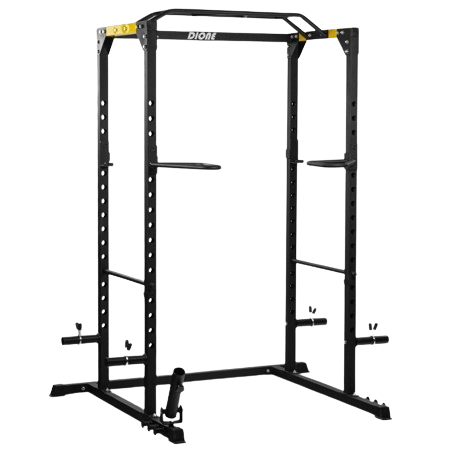
For many athletes, a Squat rack is the centerpiece of a serious home gym. Whether you are working on stronger legs, muscle growth, or general strength training, a squat rack provides the ability to train safely and effectively with free weights. However, training with heavy weights also carries risks. Without the right safety measures, incorrect movements or technical errors can lead to injuries.
One of the most underestimated safety features of a squat rack is spotter arms. This simple yet effective addition can make the difference between a safe workout and a dangerous situation when a lift fails.
In this guide, we explain how to safely use a Squat rack, why spotter arms are important, and what steps you can take to prevent injuries in your home gym.
Why safety is important when training with a squat rack
More and more people are choosing to train at home. A well-equipped home gym offers flexibility, privacy, and the ability to exercise at any time of the day. Equipment such as a weight bench, training bench, power station, or a squat rack makes it possible to effectively train almost all muscle groups.
However, what you often lack at home that you do have in a commercial gym is a training partner or spotter. When you train alone and perform a heavy squat, bench press, or overhead press, a failed repetition can cause problems.
That is why it is essential to invest not only in high-quality fitness equipment but also in safety accessories that protect you during heavy lifts.
What are spotter arms?
Spotter arms are sturdy metal arms that are attached to a squat rack. They act as a safety net when you cannot complete an exercise.
For example, if you cannot push back up during a squat, the spotter arms catch the barbell before it lands on your body or the floor.
The main benefits of spotter arms are:
• Extra safety during solo workouts
• More confidence with heavy weights
• Less risk of muscle and joint injuries
• Protection of the floor and equipment
• Ability to train more progressively
For anyone who is serious about strength training at home, spotter arms are practically indispensable.
Common injuries from improper use of a squat rack
Although a squat rack is designed for safe strength training, injuries usually occur due to user error.
Back injuries
Incorrect posture during squats often causes strain on the lower back. This happens especially when athletes add weight too quickly without sufficient technique.
Knee problems
Knee complaints often arise from insufficient mobility, incorrect foot placement, or performing half-repetitions with too much weight.
Shoulder injuries
In exercises such as overhead presses, an incorrect shoulder position can lead to irritation and strain.
Wrist and elbow complaints
A poor grip on the barbell or incorrect hand placement increases pressure on the joints.
By adjusting spotter arms correctly, you can reduce many of these risks, as you are less inclined to make dangerous compensatory movements when a lift becomes heavy.
How do you adjust spotter arms correctly?
A frequently asked question is how high spotter arms should be placed.
The ideal height differs per exercise.
For squats
The spotter arms should be placed just below the lowest point of your squat. This allows them to catch the barbell if you can no longer get back up, without interfering with the normal path of movement.
For bench press
Are you using a weight bench or training bench inside your squat rack? Place the spotter arms just below chest height when you are lying on the bench.
This way, the bar can be safely caught if a repetition fails.
For overhead presses
Place the spotter arms at a height where a falling barbell will be safely stopped without restricting your freedom of movement.
Always take the time to test the correct adjustment before you start your heavy sets.
Technique remains more important than weight
Many injuries occur because athletes focus on more weight instead of better technique.
A safe squat begins with:
• A stable foot position
• Straight back
• Active core tension
• Controlled movement
• Full range of motion
Even with spotter arms, technique remains the most important factor for injury prevention.
It is better to train with a slightly lower weight and perfect execution than with maximum load and poor form.
The importance of a stable home gym setup
A safe squat rack starts with a stable training environment.
Regularly check:
• All bolts and connections
• The flatness of the floor
• The stability of the rack
• The condition of the barbell
• Wear and tear of safety components
Many athletes combine their squat rack with other equipment such as a Smith Machine, Power station, Lat tower, or a multi-functional training system.
When multiple machines are close to each other, having sufficient room to move is extra important.
Which exercises can you safely perform with a squat rack?
A squat rack is much more versatile than many people think.
Back Squats
The most popular exercise for strength and muscle growth in the legs and glutes.
Front Squats
Ideal for quadriceps and core stability.
Bench Press
In combination with a weight bench, you can safely perform chest training.
Overhead Press
Perfect for shoulder and upper body strength.
Rack Pulls
An effective exercise for the back and posterior chain.
Barbell Lunges
Suitable for balance, coordination, and leg strength.
By using spotter arms, all these exercises can be performed more safely when you train alone.

Why more and more people choose a home gym
The popularity of the home gym continues to grow. People are looking for more flexibility, time savings, and control over their training environment.
A complete home setup often consists of:
• Squat rack
• Weight bench
• Training bench
• Weights
• Power station
• Lat tower
• Cardio equipment
Some athletes later expand their training space with a Cable Crossover or a system for wall-mounted Cable Crossover to add even more exercise options.
However, the most important thing is that safety always comes first.
Common mistakes when using a squat rack
Not using spotter arms
Many beginners think that spotter arms are only necessary for advanced lifters. In reality, beginners benefit from them the most.
Increasing weight too quickly
Progressive overload is important, but it must be done in a controlled manner.
No warming-up
A proper warm-up significantly reduces the risk of injuries.
Wrong height of the J-hooks
If the barbell is too high or too low, it can lead to unnecessary strain on the shoulders and back.
Insufficient recovery
Muscles grow during rest. Training heavily too often increases the risk of overtraining.
How do you combine a squat rack with other fitness equipment?
A squat rack often forms the foundation of a complete home gym.
Depending on your goals, you can combine it with:
• A Smith Machine for guided movements
• A Power station for versatile strength training
• A Lat tower for back exercises
• A Cable Crossover for chest and shoulder training
• A Leg trainer for targeted leg exercises
By smartly combining different machines, you create a training environment in which almost all muscle groups can be trained effectively.
Conclusion
A Squat rack is among the most valuable investments for a serious home gym, but safety should never be underestimated. Spotter arms provide extra protection during heavy lifts and give you the ability to train alone with more confidence.
By paying attention to technique, correct adjustments, and a stable training environment, you significantly reduce the risk of injury. Whether you are a beginner or have years of experience, safety always forms the basis of successful strength training.
At StrayShop, you will find various solutions for setting up a safe and functional home gym, so that you can train optimally and reach your goals responsibly.
Frequently asked questions
Are spotter arms necessary for a home gym?
Yes, especially when you train alone. Spotter arms significantly increase safety during heavy exercises.
How high should spotter arms be placed?
That depends on the exercise. For squats, place them just below the lowest point of your movement.
Can I perform a bench press in a squat rack?
Yes, in combination with a weight bench or training bench, this is a commonly used and effective setup.
What is safer: a Smith Machine or a squat rack?
A Smith Machine offers a fixed path of movement, while a squat rack gives more freedom of movement. Both have their own advantages depending on your training goals.
What equipment is a good addition to a squat rack?
Many users combine a squat rack with a Power station, Lat tower, Cable Crossover, or other fitness equipment for a complete training experience.
Can a beginner safely train with a squat rack?
Yes. With the right technique, guidance, and safety features such as spotter arms, a squat rack is suitable for both beginners and advanced users.
How do I prevent back injuries during squats?
By maintaining a neutral back position, tightening your core, and not using heavier weights than you can technically handle.
How much space do I need for a squat rack at home?
That depends on the model, but always ensure there is enough space around the rack for safe freedom of movement and access to weights.