
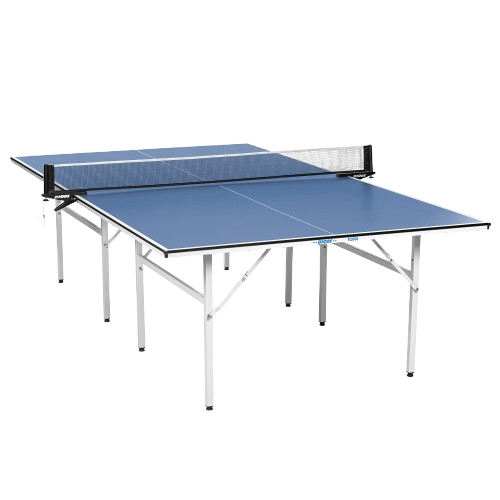
Finding a suitable table tennis table involves more choices than many people initially expect. Once you start comparing, you quickly discover a forest of specifications, dimensions, and material types. One feature stands out immediately in every comparison, and that is the specific thickness of the table tennis tabletop. This specific sizing is not just a random detail in the brochure. The top thickness is the absolute foundation for the ball bounce, the speed of the game, control over the ball, and the overall durability of the complete setup.
At StrayShop, we receive an incredible number of questions from customers about this specific component. Is a thinner model sufficient for a fun game on the weekend? Or should you immediately opt for a heavier playing field as soon as more spin and speed are involved in the game? In this extensive article, we discuss all the details together. We explain exactly what the effect of different thicknesses is on the playing field, so that everyone can make a well-informed choice that perfectly matches their personal wishes and intended level of play.
Why the tabletop thickness of a table tennis table determines the playing experience
The tabletop forms the direct point of contact for every ball that is hit. When a table tennis ball hits the surface with speed, an energy transfer occurs. The construction and the weight of the board determine the extent to which that energy is retained or absorbed by the material.
When a playing surface is too thin, the material flexes slightly at a molecular level during impact. This simply means that part of the speed and upward force is lost. The result is a lower, less predictable ball bounce. For those who play casually, that is not always a problem, but for those who want to sharpen their technique, this can be quite annoying.
- Ball consistency: A thicker playing field ensures identical bounce behavior on virtually every spot of the table, from the center to right near the edges.
- Structural rigidity: Thicker boards are less likely to warp under the influence of weight, moisture fluctuations, or long-term stress.
- Sound dampening: A solid board produces a duller, crisper sound upon ball contact instead of a hollow or tinny sound.
- Weight and stability: Heavier boards require a sturdier undercarriage, which makes the entire ping pong table more robust and less likely to shift during a heated rally.
- Wear resistance: Thicker tables generally offer a better protective layer against scratches and wear.
Tabletop thickness for recreational play in and around the house
For many households, table tennis is first and foremost a source of relaxation, exercise, and fun. The table stands in the garage, in the attic, or on the driveway. In this category, it is not always necessary to immediately purchase the heaviest playing field. Nevertheless, within the recreational range, there are clear differences in quality and playing comfort.

12mm to 15mm: The light entry-level class for occasional use
Playing fields with a thickness between 12mm and 15mm fall into the absolute entry-level category for indoor table tennis tables. These tables are very often chosen by families with young children or people who only pick up a paddle a few times a year.
- Lightweight: These tables are very easy to fold, store, and move by one person.
- Attractive price: It is the most affordable option for those who want to start on a limited budget.
- Limited bounce: The ball bounces noticeably lower and quickly loses speed after the bounce.
- Sensitivity: Thin boards are more sensitive to slight warping if they are stored in a humid or fluctuating environment.
When the focus is primarily on teaching children their very first strokes, this category is perfectly fine. However, those who have already developed a feel for the ball will notice the limitations in the ball bounce relatively quickly.
16mm to 19mm: The ideal mid-range for the whole family
In our assortment, we notice that thicknesses from 16mm to 19mm are by far the most popular choice for home use. This category is often seen as the golden middle ground between affordability and high-quality performance.
- Natural bounce quality: The ball bounce is high enough and consistent enough to build up a smooth, fast-paced rally.
- Good balance: The table offers enough mass for a stable base without making the folding process awkwardly heavy.
- Suitable for all ages: Both beginners and experienced friends can play a challenging game on this thickness.
- Good value for money: Excellent durability for years of intensive home use.
Tables in this thickness class offer exactly the fine playing experience needed to stand at the table for hours with pleasure, without the ball pinging away unpredictably.

Tabletop thickness for fanatic play and athletic performance
As soon as the approach to the game shifts from recreational pastime to serious sports practice, the requirements for the equipment change drastically. Fanatic players train for consistency, speed, placement, and the application of topspin and backspin.
22mm to 25mm: Club quality and approved competition levels
The International Table Tennis Federation (ITTF) sets very strict requirements for playing fields used during official tournaments. One of the most important requirements is that a standard table tennis ball dropped from a height of 30 centimeters must bounce exactly 23 to 26 centimeters straight up anywhere on the board. This level of precision is almost exclusively achieved with a tabletop thickness of 22mm to 25mm.
- Maximum bounce: The ball's energy is returned optimally, which ensures a dynamic and extremely reliable game.
- Optimal spin acceptance: The surface reacts exactly as it should to spin shots, which is essential for training advanced techniques.
- Extremely solid frame: Tables with this thickness have a heavy steel undercarriage that remains unshakably in place.
- Long lifespan: These boards are built for daily, hour-long use without the surface showing wear in terms of bounce quality.
For club players who want to experience exactly the same conditions at home as at their club, a thickness of at least 22mm is the absolute standard.
The crucial difference between indoor and outdoor table tennis tops
When assessing the right dimensions, it is necessary to make a clear distinction between indoor use and outdoor use. An indoor table tennis table uses very different materials than an outdoor table tennis table, which means the millimeters cannot be directly compared one-to-one.
Indoor tables: Solid compressed wood (MDF)
Indoor playing fields are made of high-quality compressed wood fiber, better known as MDF. Wood naturally possesses excellent springy properties that are highly suitable for table tennis.
- A 19mm MDF board already provides a very representative and high ball bounce.
- Wooden boards are exclusively suitable for dry indoor spaces.
- Moisture, direct sunlight, or large temperature fluctuations can permanently damage an indoor wooden board.
- The density of the wood ensures a very even and natural ball response.
Outdoor tables: Melamine resin and aluminum sandwich boards
A table that stays outside all year round in the garden or on the patio must be able to withstand rain, snow, UV radiation, and frost. Wood would quickly swell and warp in such conditions. That is why outdoor tables are equipped with boards made of melamine resin or an aluminum combination.
- Melamine resin boards are much harder and more compact than wooden boards.
- Due to this high density, a melamine board is thinner in millimeters (usually between 4mm and 10mm).
- A 6mm to 7mm melamine resin board provides a bounce that, in terms of experience, is comparable to a 19mm indoor MDF board.
- For a truly good outdoor playing experience, we advise never going below 5mm melamine.
Handy buying guide per user type
To keep the overview clear, we have put together a handy matrix based on different user profiles and their specific needs.
- The casual family user:
- Goal: Relaxed play with the children in the garage or garden.
- Advice Indoor: 16mm MDF.
- Advice Outdoor: 5mm melamine resin.
- Focus: Safe folding, easy to handle, and competitively priced.
- The fanatic hobbyist:
- Goal: Regular matches among friends, training for technique and speed.
- Advice Indoor: 19mm to 22mm MDF.
- Advice Outdoor: 6mm to 8mm melamine resin.
- Focus: High, consistent ball bounce and a sturdy frame.
- The club and tournament player:
- Goal: Training at home at exactly the same level as in the sports hall.
- Advice Indoor: 22mm to 25mm solid MDF (ITTF approved).
- Advice Outdoor: 10mm melamine resin or heavy fixed outdoor setup.
- Focus: Maximum precision, heavy construction, and refined spin bounce.
- Schools, companies, and public spaces:
- Goal: Intensive daily use by many different people.
- Indoor advice: 22mm MDF with reinforced edge trim.
- Outdoor advice: 8mm to 10mm melamine resin with firmly anchored base.
- Focus: Vandal resistance, extremely robust frames, and scratch-resistant top layers.
Other factors affecting play quality
Although the thickness of the playing surface plays the main role, we must not lose sight of the rest of the construction. A thick tabletop requires the right support to perform optimally.
The steel edge trim and the base
The edge trim is the steel profile mounted directly under the edge of the tabletop. This component plays a crucial role in maintaining its shape.
- A wide edge trim of 40mm to 60mm prevents the playing surface from sagging over time.
- The profile distributes forces across the entire table, reducing vibrations during hard shots.
- A sturdy base with thick steel legs ensures the table stands rock-solid on the ground.
Adjustable legs and transport wheels
No floor or tiled patio is one hundred percent level. A crooked table ruins the playing experience, regardless of how thick the board is.
- Always choose a model with height-adjustable leveling feet to set the table perfectly level.
- Large double transport wheels with a rubber tread make it easy to move a heavy table safely.
- A reliable braking system on the wheels prevents unwanted sliding during an exciting game.
Maintenance tips for a long-lasting tabletop
To ensure that ball bounce and the grip of the top layer remain optimal year after year, periodic maintenance is essential. Simple actions make a world of difference here.
- Regular dusting: Dust and dirt reduce grip on the ball. Wipe the table after use with a soft, slightly damp microfiber cloth.
- Use of a protective cover: Always protect an outdoor table with a well-fitting, breathable protective cover. This prevents rain, leaves, and bird droppings from damaging the protective layer.
- Avoid harsh agents: Never use abrasive cleaners or chemical solvents. Specially developed table tennis cleaners maintain the matte finish and the friction of the lacquer layer.
- Fold dry: Ensure the table is completely dry before folding it and placing it under a cover. This prevents mold growth.
- Check net tension: Make sure the net is not set too tightly to avoid excessive tension on the center line.
Personal advice when making the right choice
At the StrayShop store, we notice that choosing a game table is very personal. What might be a fine table for one person's garden may not offer the desired precision for someone else. It is therefore always wise to look closely at the room where the table will be placed and the frequency with which it will be played.
Do not forget the necessary playing space around the table. The table itself has a standard size of 274 cm long and 152.5 cm wide. For a pleasant experience, at least 1.5 to 2 meters of free space is needed on both sides to move freely and handle backward shots.
In rooms where freedom of movement is limited, a table that is too large or too heavy can sometimes be obstructive. A well-thought-out plan for placement and storage prevents disappointment later.
Conclusion: Choose the playing surface that matches your ambitions
Determining the right tabletop thickness ultimately comes down to an honest assessment of your own playing style, the desired ball bounce, and the available budget. For a casual game with the family, a medium-weight playing surface between 16mm and 19mm (indoor) or 5mm and 7mm (outdoor) offers a fantastic combination of fun and ease of use. Those who train at a high level or simply want the best possible bounce quality at home should opt for a solid playing surface of 22mm to 25mm.
By paying attention to both the plate thickness and the quality of the base and edge trim, you are guaranteed an setup that ensures years of sporting enjoyment. Feel free to browse the extensive range at StrayShop to compare different models and find the perfect match for your playing space!
Read More:
Which table tennis table best fits your garden or terrace
Table tennis table for indoors: which room is ideal for comfortable playing