
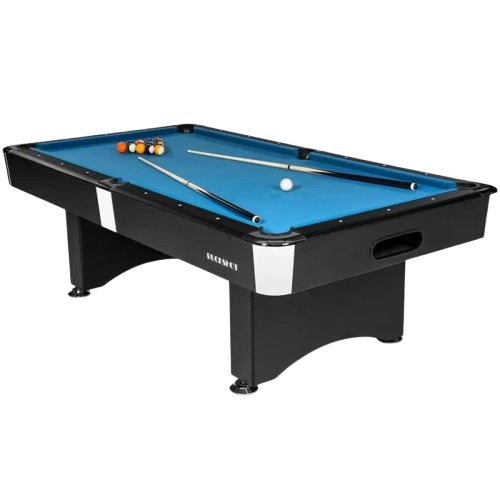
Getting your own pool table at home turns every evening with friends or family into a sporty and social gathering. When the focus is primarily on playing 8-ball, specific requirements arise regarding the equipment, dimensions, and finish of the table. After all, not every game table provides the exact same experience when fifteen colored balls are set up in a tight triangle, waiting for a powerful break.
Choosing a suitable pool table for your home requires attention to practical details. This is not only about the square footage available in the room, but also about floor loading, the quality of the rubber cushions, and the type of playfield. At StrayShop, we help enthusiasts find the right equipment for their specific playing style every day. In this comprehensive guide, we share all our insights so that the decision for an 8-ball pool table becomes clear and well-informed.
Understanding the specific requirements of 8-ball
The game of 8-ball is the most played variant of billiards worldwide. The game's principles require a balanced combination of tactical positioning, precise spin, and controlled power. Because there are sixteen balls on the cloth at once, the dynamics on the table are different than in variants such as 9-ball or snooker.
During the familiar 8-ball break shot, significant force is applied to the cluster of balls. A solid frame is therefore necessary to absorb unwanted vibrations and prevent movement in the undercarriage. Furthermore, the game requires that the balls roll predictably when they collide in crowded situations around the pockets. A small irregularity in the surface can cause a strategically placed shot to fail completely.
To optimally enjoy this game type, we mainly look at three key basic elements:
- The overall stability of the base during powerful breaks.
- The flatness and friction of the pool cloth for a consistent roll speed.
- The accuracy and the cut of the pockets and the corner cushions.
Pool table dimensions: What fits in your space?
Determining the right size is the first and most crucial step when purchasing a pool table. A table that is too large for a confined space leads to frustration during play, as the back wall or a piece of furniture hinders the cueing motion. Conversely, a table that is too small does not provide the desired sporty challenge for an adult player.
When measuring the playing area, we always follow a simple rule. There should be at least the length of a standard cue (approximately 145 centimeters) of free space on all sides of the table. This provides the necessary freedom of movement for a relaxed shot.

6ft pool tables: Compact and accessible
A 6ft pool table has a playing area of approximately 180 by 90 centimeters. This size is extremely suitable for homes where available space is scarce, such as a small hobby room, attic, or insulated garage. For young players and beginners, this size immediately offers a lot of playing fun.
- External dimensions: Approximately 200 by 110 centimeters.
- Minimum space: Approximately 4.70 by 3.80 meters.
- Advantages: Takes up little space, is lighter in weight, and is often competitively priced.
- Disadvantages: Balls cluster together quickly, which can slightly limit the tactical options in 8-ball.
7ft pool tables: The golden mean for the home
For most living rooms, basements, and man caves, the 7ft pool table is the absolute favorite. With a playing surface of approximately 198 by 99 centimeters, this size offers a great balance between playing quality and space savings.
- External dimensions: Approximately 225 by 125 centimeters.
- Minimum space: Approximately 4.90 by 3.90 meters.
- Advantages: Offers plenty of playing surface for complex 8-ball patterns without requiring a huge room.
- Utility: This is the most popular size for private use in the Netherlands and Belgium.
8ft pool tables: Close to the official competition experience
Those who have enough square footage and are looking for a realistic club feel will end up with an 8ft pool table. The playing surface of approximately 224 by 112 centimeters requires more precision and offers plenty of room for long positional shots.
- External dimensions: Approximately 250 by 140 centimeters.
- Minimum space: Approximately 5.20 by 4.10 meters.
- Advantages: Excellent practice environment for advanced billiard players who want to sharpen their technique.
- Note: Requires a sturdy floor construction due to the increased weight.
9ft pool tables: The professional tournament standard
This is the official size used in international tournaments and professional pool halls. With a playing field of 254 by 127 centimeters, a 9ft pool table requires a spacious room.
- External dimensions: Approximately 280 by 150 centimeters.
- Minimum space: Approximately 5.50 by 4.30 meters.
- Features: Offers the highest degree of precision, but due to its size, it is rarely practical for the average home.
Shorter cues for tight corners
If the room has a narrow passageway or a load-bearing column, this does not have to be an obstacle. With a shorter cue of 120 or 130 centimeters, specific shots along the wall can be executed effortlessly. This keeps the game flowing smoothly without damaging the wall or furniture.

Lighting and the right environmental factors
In addition to the space around the table, lighting is very important for 8-ball. A good pool table lamp hangs centered above the playing field, at a height of approximately 80 to 90 centimeters above the cloth. This prevents annoying shadows around the balls, which is essential when judging thin cut shots. The type of floor also plays a role. A hard, level surface helps to easily level the table using the leveling feet under the legs.
Slate vs. MDF: The playfield for 8-ball
The core of the pool table determines how the ball rolls and how durable the playfield is over a longer period. The choice is almost always between a wooden MDF playfield and a natural slate playfield. Both materials possess unique properties that directly affect the playing experience during a game of 8-ball.
MDF playfields: Budget-friendly and lightweight
An MDF pool table uses high-density pressed wood as a surface. This material is significantly lighter and cheaper to produce.
- Weight and mobility: Because the weight remains relatively low, the table is easier to assemble and potentially move.
- Environmental sensitivity: Wood reacts to fluctuations in humidity and temperature. In a damp basement or unheated room, the board may show slight warping over time.
- Target audience: Excellent for recreational use with family or friends, provided the room is well-conditioned.
Slate playfields: The professional standard
A slate pool table uses a heavy, natural stone slab that has been ground flat with extreme precision. This material can consist of a single slab or three separate parts that fit together seamlessly.
- Purity of the roll: Slate is completely insensitive to temperature differences and moisture. The surface is guaranteed to remain flat for a lifetime.
- Mass and rigidity: The enormous weight provides a rock-solid foundation. When the fifteen balls are scattered with force during the break, the table remains perfectly still.
- Target audience: The best choice for those seeking the authentic playing experience of a sports club.
Comparison of playfields
To present the differences clearly, the main characteristics are listed below:
- MDF Playfield:
- Weight: Light to medium (40 to 90 kilograms).
- Flatness: Good upon purchase, can work slightly over time.
- Lifespan: Approximately 3 to 8 years with regular use.
- Assembly: Often easy to perform yourself.
- Costs: Accessible entry-level prices.
- Slate Playfield:
- Weight: Heavy (180 to 450 kilograms).
- Flatness: 100% Immutable and permanently flat.
- Lifespan: Unlimited, lasts a lifetime.
- Assembly: Requires accurate leveling.
- Costs: Investment in the higher segment.
Cloth, cushions, and pockets: The details that make the difference
A sturdy base and a taut bottom board form the basis, but the actual ball contact takes place on the cloth and against the cushions. For the strategic course of an 8-ball match, these parts play a key role.
Choosing the right pool cloth
The pool cloth determines the degree of friction and thus the speed of the ball. We distinguish two main types:
- Woolen cloths (Slower cloths): Contain a high percentage of wool and have a visible nap. This provides more resistance, causing the cue ball to slow down faster. This offers plenty of control for short shots on recreational tables.
- Worsted cloth (Speed cloth): Woven from tightly twisted threads with a smooth surface. The balls roll effortlessly over long distances. This type is ideal for applying spin and precisely positioning the cue ball in 8-ball.
Cloth color choice and contrast
Although traditional green cloth is very popular, blue and gray cloths are gaining popularity for 8-ball. A blue cloth offers excellent contrast with both the yellow and red balls. This increases visibility during long evening gaming sessions and reduces eye strain.
Rubber cushions and resilience
The bounce of the ball against the rubber cushions should be consistent and quiet. High-quality profile cushions (such as the K-66 profile) ensure that the angle of incidence is exactly equal to the angle of reflection.
- Good rubber cushions do not dry out and retain their resilience.
- Proper cushion quality prevents the ball from bouncing unexpectedly during a hard shot.
Pocket profiles and ball collection
In 8-ball, many balls are pocketed in a short time. The design of the pockets affects comfort while playing:
- Drop pockets: Soft collection pockets where the balls come to a rest. This ensures a quiet sound when pocketing.
- Central ball return system: An internal gutter system collects the pocketed balls at the head of the table. This significantly speeds up setting up the next rack.
Practical features for home use
Furnishing a home often requires smart management of available space. A pool table can be perfectly combined with other living functions.
Dining pool tables: The stylish 2-in-1 solution
A multifunctional dining pool table is equipped with a matching cover plate. In the blink of an eye, a spacious dining table turns into a full-fledged playing field.
- Aesthetics: Sleekly finished with high-quality wood or a steel frame that fits into a modern interior.
- Functional: No separate room needed; the table is central to the living area.
Foldable pool tables
For rooms that serve multiple purposes, a foldable pool table offers a solution. After playing, the base can be easily folded, after which the table can be stored upright against a wall.
Maintenance tips for an optimal playing experience
To extend the lifespan of an 8-ball pool table and maintain optimal playing pleasure, regular maintenance is recommended. With a few simple steps, the playing surface remains in top condition:
- Brushing the cloth: Regularly brush the cloth in one direction (from the head spot to the foot spot) to remove dust and chalk residue.
- Covering after use: Always use a suitable protective cover when not playing. This prevents discoloration from sunlight and dust accumulation.
- Cleaning pool balls: Regularly clean the balls with a damp cloth or a special ball cleaner. Clean balls wear out the cloth significantly less quickly.
- Leveling the playing field: Check at least every six months whether the table is still exactly level using a precision spirit level. A slight deviation directly affects the roll trajectory of the cue ball.
Important accessories for the perfect 8-ball experience
The experience at the table is made complete by the right tools. For playing 8-ball, we recommend the following items:
- High-quality pool balls: Choose balls with the standard diameter of 57.2 mm. High-quality resin balls retain their balance and leave no marks on the cloth.
- Sturdy triangle: A tight-fitting triangle is essential to place the fifteen balls tightly together for a powerful break shot.
- Balanced cues: A cue with a layered leather tip of 12 to 13 mm offers the desired control over the cue ball.
- Chalk: Prevents miscues and ensures optimal transfer of spin to the cue ball.
Why choose StrayShop?
At StrayShop, we understand that purchasing a game table is a thoughtful choice. In our spacious showroom, various models are set up for you to try out yourself. Our specialists offer personal advice, fast delivery, and excellent after-sales service. Whether you prefer a flexible family model or a professional slate version, quality always comes first at StrayShop.
Conclusion: Choose the right pool table for your 8-ball evenings
Selecting the ideal pool table for playing 8-ball contributes to years of gaming enjoyment at home. Those primarily looking for relaxed entertainment with the family make an excellent and practical choice with an MDF 7ft pool table. Enthusiasts striving for maximum precision, an indestructible playing surface, and an authentic club experience should invest in a slate pool table. By carefully measuring the space in advance and paying attention to the finish of the cushions and the cloth, you create the perfect setup for countless sporty 8-ball duels.
Read More :
Pool rules: everything you need to know for the perfect game
Which game table fits your family: pool table, foosball table, or table tennis table?