
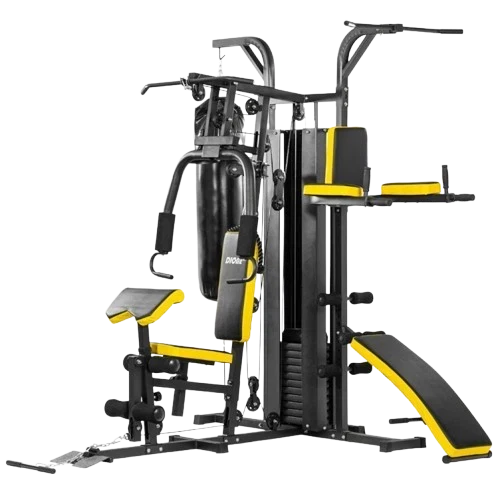
Ordering your own treadmill, rowing machine, or home gym is a fantastic step toward a healthier lifestyle. We see daily how excited people get when they decide to set up their own workout space. Yet, the biggest challenge often doesn't arise while choosing the right equipment, but the moment the delivery truck pulls up to the door. Having heavy fitness equipment delivered at home requires more than just opening the front door. Modern training gear is robust, heavy, and often significantly bulkier than anticipated.
In practice, we regularly see packages getting stuck in the hallway, wedged in the stairwell, or simply unable to make a turn in the corridor. That is an enormous waste of time and can furthermore cause damage to walls, door frames, or the valuable equipment itself. To ensure that the delivery of heavy fitness machines goes flawlessly and smoothly, we have clearly listed all the crucial points of attention.
With thorough preparation of doors, stairs, and passageways, your new training partner will be exactly in the right spot in no time.
Preparing the delivery route in your home
Before the delivery drivers arrive, it is wise to carefully analyze the entire route from the street to the final workout space. We recommend physically walking this route yourself with a tape measure in hand. In this way, any potential bottlenecks will immediately become apparent before the weight of the package starts to play a role.
To measure is to know: determining the exact dimensions
Many buyers look exclusively at the dimensions of the assembled fitness machine while orientation. During actual transport, however, it is about the box in which the device is packaged. The packaging in which a treadmill is delivered at home is significantly wider, longer, and higher than the assembled machine itself. After all, inside the box, there is protective padding material to prevent transport damage during the journey.
Therefore, we always check two different sets of measurements beforehand:
- Box dimensions: This data is stated on the product page or in the manufacturer's specifications. This is the size that doors and hallways must accommodate.
- Assembled dimensions: These dimensions are important for determining whether the machine fits in the intended spot in the room, including sufficient space for movement around it.
When measuring passageways, always account for an additional safety margin of at least five to ten centimeters on both sides. This space is necessary for the delivery drivers' hands so that they can lift the weight safely without fingers getting trapped between the package and the door frame.
Checking door frames and turning circles
A common bottleneck when transporting fitness equipment through doors is not so much the height of the door frame, but the available width. Standard interior doors in older homes are often only 70 to 75 centimeters wide, while large cardboard boxes can easily be 80 to 90 centimeters wide.
In addition to the direct width of the doorway, the turning circle immediately behind it is of crucial importance. While an elongated package for a rowing machine or treadmill might pass through the doorway, if there is a sharp turn in the hallway directly behind the door, the box can get jammed. We advise measuring turning circles by using an elongated cardboard strip or a wooden slat that has the same length as the packaging.

Avoiding obstacles in doors and hallways
A clear passage means more than just an empty floor. Various subtle obstacles in the hallway or corridor can unnoticeably hinder transport or cause damage while moving heavy equipment.
Temporarily removing or securing doors
When a doorway turns out to be just a few centimeters too narrow, it does not have to be a problem. A simple solution we often apply is to temporarily remove the interior door from its hinges. This immediately yields two to four centimeters of extra width because the door leaf itself is no longer in the passage.
Moreover, removing the door prevents the door leaf from swinging back and forth or hitting the delivery drivers while lifting. Also, don't forget doorstops, door handles, and surface-mounted hinges. If possible, protruding handles can be temporarily unscrewed to gain valuable centimeters when navigating a narrow passage with fitness equipment.
Baseboards, thresholds, and narrow hallways
Thresholds and high baseboards can make the use of a hand truck extremely difficult. When a heavy box must be lifted or rolled over a high threshold, the center of gravity of the weight shifts suddenly, which can lead to dangerous situations.
We recommend taking the following precautions to protect your home and the equipment:
- Threshold ramps or small wooden ramps: Place a small sloped ramp over high thresholds so transport wheels can roll over them smoothly.
- Wall and corner protection: Cover vulnerable plaster corners, baseboards, or paintings in narrow hallways with moving blankets or sturdy cardboard.
- Floor protection: Lay down floor runners or thick cardboard sheets on wooden floors, poured floors, or vulnerable laminate to prevent scratches and dents.
Moving fitness equipment to an upper floor or attic
Moving heavy fitness equipment up the stairs is by far the greatest physical challenge of the delivery. Stairwells in homes are often built compact and steep, which requires specific safety measures.
Straight stairs versus spiral staircases
A straight, wide staircase rarely presents problems in most cases, provided there is sufficient clearance at both the top and bottom of the stairs to maneuver the long package properly. A spiral staircase, however, is a different story.
When transporting a fitness machine via a spiral staircase, the available depth of the steps varies greatly. In the middle of the stairs, the steps are extremely narrow, leaving delivery drivers with little standing room and a limited point of support. In such situations, it is often necessary to unpack the machine downstairs and carry it up in separate, lighter components. Always check in advance whether the device in question lends itself to partial disassembly.
Load-bearing capacity of the stairs and safety of the delivery drivers
Safety always comes first. A professional home gym or a robust commercial treadmill can easily weigh between 90 and 160 kilograms. When this weight is combined with the body weight of two delivery drivers, there is an enormous load on a single point of the stairs.
Check in advance whether the staircase is structurally firmly anchored and whether there are any loose stair coverings or slippery steps. Applying temporary anti-slip strips or removing a loose stair runner can prevent serious slips. Also, ensure that the lighting in the stairwell is working optimally.
Which fitness equipment presents the most challenges?
Not every fitness device makes the same demands on the logistics route. Depending on the specific type of cardio or strength equipment, the bottlenecks and necessary preparations differ significantly.
Treadmills and rowing machines (length and weight)
Treadmills are definitely among the heaviest and most rigid machines to move. The powerful electric motor, the steel frame, and the massive running deck together form a compact, dead-weight unit that is barely flexible. Bringing a treadmill upstairs via the stairs almost always requires several strong people and a minimum passage width of at least 80 to 85 centimeters.
Rowing machines, on the other hand, are often a lot lighter in terms of total weight, but their considerable length can be very cumbersome in narrow hallways. Fortunately, most modern rowing machines can easily be separated into two distinct parts in the middle. This makes navigating through narrow doors significantly easier.
Crosstrainers, home gyms, and dumbbells
Crosstrainers are characterized by an irregular weight distribution. The heavy flywheel is located at the front or back, meaning the center of gravity is not in the middle. Furthermore, the pedal arms and handlebars often stick out widely when the device is already partially pre-assembled in the box.
For home gyms and weight sets, a completely different logistical principle applies:
- Home gyms: These are usually delivered in several separate boxes. The challenge here is not so much the size of the individual packages, but the total weight of the included weight stacks.
- Dumbbell sets and barbells: Delivered in very compact, but extremely heavy packaging. Ensure the walking route is completely free of obstacles, as delivery drivers might partially lose their view of the floor.
Our practical checklist for a flawless delivery
To ensure nothing is left to chance, we have put together a clear checklist. We advise running through these points thoroughly on the day before the scheduled delivery.
- Box dimensions checked: Outer dimensions of the packaging compared with the narrowest door frame and hallway width.
- Walking route completely cleared: Paintings, coat racks, shoe racks, planters, and rugs along the route temporarily removed.
- Turning circles tested in advance: Sufficient space verified at right-angled corners in hallways, corridors, or stairwells.
- Floors and walls protected: Floor runners, cardboard, or moving blankets laid down on vulnerable surfaces and along walls.
- Pets and children at a distance: Ensure a safe environment where the delivery drivers can work undisturbed.
- Parking space in front of the door arranged: Reserved sufficient space for the large delivery van as close to the main entrance as possible.
Why StrayShop's service makes the difference
When purchasing high-quality sports equipment, a reliable logistics partner is invaluable. We at StrayShop understand that delivering physically heavy equipment requires specific attention and customization. Thanks to our years of experience in the fitness industry, we know exactly which questions need to be asked in advance to prevent unpleasant logistical surprises at the door.
When you choose StrayShop, you choose not only top products of excellent quality but also expert guidance throughout the entire ordering and delivery process. We are happy to actively think along with you about the accessibility of your home and advise on the most practical transport options for your specific situation. This way, we ensure together that your new equipment arrives at the desired location quickly, safely, and without damage. With the professional support of StrayShop, nothing stands in the way of your athletic goals.
Conclusion: a carefree start to your own home gym
Thorough preparation is proven to be half the work when setting up your own sports space at home. By accurately measuring doors, stairs, and passageways in advance and removing any obstacles in time, you prevent unnecessary stress, physical strain, and damage during delivery.
With our practical tips, clear measuring instructions, and handy checklist, you ensure a safe, fast, and flawless delivery of your new machine. Smooth transport is the foundation of a successful purchase. This way, you can immediately begin achieving your fitness goals with full energy in the comfort of your own home.
Read More :
How much weight do you need in a home gym if you want to get stronger?
How do you prevent noise and vibrations from fitness equipment at home?