
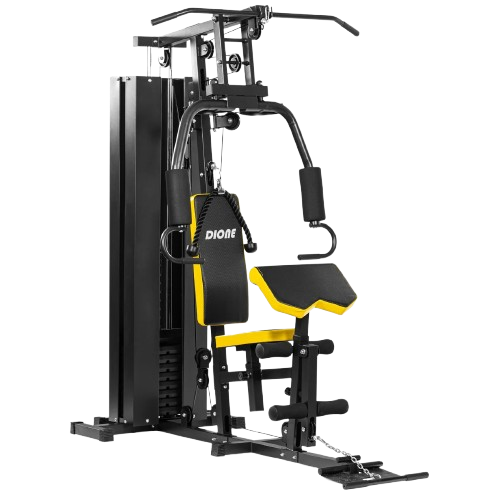
Training at home has been gaining popularity for years, and equipping a personal home gym is the ultimate step toward physical freedom for many athletes. When choosing a versatile strength station, we often encounter the same crucial question in practice: how many kilograms of resistance are actually needed to make getting stronger possible in the long term? The range on the market varies enormously, from compact devices with a built-in 50-kilogram weight stack to robust equipment that uses individual weight plates and can handle loads of up to hundreds of kilograms.
Making the right choice prevents a machine from no longer offering enough of a challenge after just a few months. Conversely, it is also unnecessary to invest immediately in an extremely heavy professional system when training goals are primarily focused on general fitness and muscle toning. In this article, we share all the practical insights needed to determine exactly what weight fits specific training goals, various exercises, and individual experience levels.
The foundation of muscle building and progressive overload
Every human body adapts based on the physical stimuli it receives. When the goal is to build muscle strength and muscle mass, the principle of progressive overload plays a central role. This means that muscles must periodically be subjected to heavier loads than they are accustomed to. Without this progressive stimulus, physical progress stalls at a plateau.
When selecting fitness equipment for the home, we therefore look not only at what we can lift today, but especially at the growth potential over the next year or two. Efficient home strength training requires that there is sufficient room to increase training resistance step by step.
How muscle growth and muscle strength really work
Muscle tissue grows when it is put under tension and small microtraumas occur in the muscle fibers. The body then repairs these fibers and makes them thicker and stronger to better handle future loads. This process requires mechanical tension that is high enough to challenge the body.
There are two ways to increase the load on the muscles:
- Increasing the weight step by step for the same number of repetitions.
- Increasing the number of repetitions or sets with a constant weight.
Ultimately, increasing the weight is the most direct way to stimulate muscle building. A high-quality strength station should be able to support these weight increments smoothly, in a controlled manner, and safely.

How much weight fits your training level?
The required capacity of a device depends heavily on the current physical level and personal ambition. We generally divide athletes into three clear categories to provide clarity.
Beginners: starting with the right foundation
Athletes who are just starting with structured strength training at home do not initially need extremely heavy weights. The focus at the start is primarily on learning correct movement execution and strengthening tendons and joints.
A fixed weight stack of 60 to 70 kilograms is more than enough for most beginners for the upper body. Think of exercises such as the lat pulldown, chest press, and seated row. For the leg muscles, however, 60 kilograms may quickly feel on the light side over time, as large muscle groups like the quadriceps and glutes can tolerate more resistance.
Advanced: the step to heavier weights
After 6 to 12 months of consistent training, physical tolerance changes significantly. The muscles have adapted, and the initial weights no longer provide sufficient stimulus for further muscle strength.
Advanced athletes achieve the best results with a strength station that offers a minimum resistance of 80 to 100 kilograms. With this weight, compound exercises like heavy chest presses and cable rows can be performed effectively. At StrayShop, we see that many dedicated home athletes in this category choose expandable systems or devices that can be combined with a built-in Smith machine.
Experienced athletes: maximum load and challenge
For seasoned strength athletes and bodybuilders, a standard 80-kilogram weight stack is simply insufficient. The large muscle groups require significant weights to be driven to muscle failure within the optimal repetition range of 6 to 12 reps.
Experienced athletes often need a maximum resistance of 120 to 150 kilograms or more. At this stage, a plate-loaded system, where individual weight plates are placed on the weight sleds, becomes a very attractive option. This offers virtually unlimited potential for growth without hitting the mechanical limits of the device quickly.
The difference between weight stacks and individual plates
The way resistance is generated in a strength station is a determining factor in the amount of weight needed and how the device feels during movement.
Strength stations with a fixed weight stack
Machines with an integrated weight stack use a selector pin that allows the desired weight to be chosen quickly and easily.
The advantages of this system:
- Quick weight changes, which is ideal for drop sets and supersets.
- Safe to use with no loose plates on the floor.
- Compact construction that takes up relatively little space in the room.
The disadvantage is that the maximum weight is fixed. Once the maximum weight of, for example, 90 kilograms is reached, the device cannot easily be made heavier without complicated modifications.
Strength stations with weight plates (Plate-loaded)
Plate-loaded systems use individual weight plates that are manually loaded onto the machine.
Characteristics of plate-loaded systems:
- Unlimited scalability by adding extra plates.
- Possibility to reuse existing weight plates from the home gym.
- Often a higher maximum load capacity for heavy exercises such as the leg press or bench press.
This type of device requires a bit more time when changing weights but offers the most flexibility in the long run for athletes who have building muscle strength as their primary goal.
Cable pulleys, sheaves, and effective resistance
An important technical point that is often overlooked when comparing equipment is the gear ratio of the pulleys. The weight indicated on the stack is not always the actual force that the muscles must exert.
Why a 1:1 or 2:1 ratio makes a big difference
In the world of fitness equipment, two pulley ratios are mainly found:
- 1:1 Ratio: 10 kilograms on the stack feels exactly like 10 kilograms at the handle. This is often seen in classic lat pulldown stations and single-pulley systems.
- 2:1 Ratio: 10 kilograms on the stack provides 5 kilograms of actual resistance at the handle. This system is widely used in a cable crossover and functional trainers.
A 2:1 ratio provides a longer cable travel and extremely smooth movement, which is perfect for explosive exercises and isolation exercises. It does mean, however, that with a 100-kilogram weight stack, only 50 kilograms of effective resistance per side is available. When selecting the right model from the StrayShop assortment, we always advise paying close attention to these cable ratios so that the resistance matches personal expectations.
Which muscle groups and exercises require the most weight?
Not every muscle group needs the same amount of weight. To get a realistic view of the total weight requirement, we look at the specific exercises performed on the machine.
Exercises for leg training
The legs contain the largest and strongest muscle groups in the human body. Exercises such as the leg press, hack squat, and donkey calf raises require significantly more weight than upper-body exercises.
A strength station that only goes up to 60 kilograms will quickly prove to be an insufficient challenge for most adults with a leg press module. For a full-fledged leg workout, a resistance of at least 100 to 120 kilograms is desirable.
Push and pull exercises for the upper body
For the chest and back muscles, the weight requirements are in the middle range. Compound exercises like the chest press, lat pulldown, and seated cable row require solid resistance.
Guidelines for upper-body exercises:
- Lat Pulldown: 60 to 90 kilograms for effective back training.
- Chest Press: 50 to 80 kilograms for powerful chest development.
- Seated Row: 60 to 90 kilograms for complete back coverage.
Isolation exercises for arms and shoulders
Small muscle groups like the biceps, triceps, and shoulders need much less weight to be optimally stimulated. Exercises such as tricep pushdowns, bicep curls, and lateral raises are generally performed with weights between 15 and 40 kilograms. A fine-grained weight distribution with small increments of 2.5 to 5 kilograms is essential for these movements to prevent injuries and maintain strict form.
Practical guidelines for purchasing your ideal device
Making a well-considered choice requires a good balance of different factors. We have compiled an overview of practical points to consider that help in determining the right capacity:
- Determine the main objective: Is the goal primarily rehabilitation, general conditioning, or maximum muscle building?
- Consider the cable systems: Check whether the weight stack is based on a 1:1 or 2:1 ratio.
- View the expansion possibilities: Does the device offer the option to add extra weight later or place pegs for resistance bands?
- Invest in safety and stability: Heavier weights require a robust frame made of high-quality steel with a wide base.
- Test the device if possible: At StrayShop, we offer the possibility to view and try out fitness equipment in our showroom, so that the resistance and the movement of the cables can be experienced firsthand.
How do you combine a strength station with free weights?
A versatile approach to home strength training combines the best of both worlds. A strength station offers excellent support, cable resistance, and safety when training alone without a spotter. Combining this with free weights and an adjustable bench creates a complete training environment.
Many modern fitness machines now integrate a guided Smith machine into the structure. This allows heavy squats and pressing exercises to be performed safely with free weight plates, while the cable modules are used for controlled isolation exercises. This combination ensures that there is never a shortage of training weight.
Conclusion: Choose the right weight for long-term progress
Determining the ideal weight for a strength station is a crucial step for anyone who wants to get seriously stronger. For beginners, a 60 to 70-kilogram weight stack usually suffices in the first phase, but those who want to keep growing in the long term would be wise to look at devices with a capacity of 90 to 100 kilograms or choose a plate-loaded system with weight plates.
Always take into account the pulley ratios of the cable crossover and cable stations, as these halve the actual resistance with a 2:1 ratio. By choosing a high-quality and expandable device, we lay the foundation for years of effective, safe, and enjoyable home training.
Read More:
Which weight bench do you need for heavy bench pressing? Pay attention to load capacity and stability
Having fitness equipment delivered to your home: what should you pay attention to regarding doors, stairs, and passageways?