
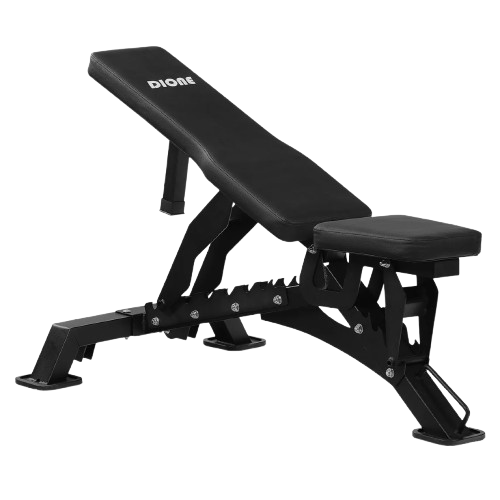
A good adjustable weight bench is indispensable for anyone training at home. It forms the foundation of almost every strength training session. Many people quickly buy the first model they see, which is a missed opportunity. Your seating position determines how much force you can safely exert, and the available training angles make a huge difference in your muscle development.
With the right bench, you train smarter. You instantly feel more grip, and your body is properly under tension. An incorrect position, by contrast, puts pressure on the wrong joints, putting significant strain on your shoulders and lower back. A few simple insights can easily help you avoid this.
At StrayShop, you will find many different benches for the home athlete. Which model truly suits your goals? In this comprehensive guide, we look at all the important points. We discuss angles, settings, padding, and ergonomics so that you can easily make a smart choice.
Why the right seating position makes the difference
A stable seating position is the foundation of every safe exercise. Without proper support, you will start to compensate, meaning your muscles work less effectively. Moreover, the risk of nasty injuries increases rapidly.
Support for the lower back
The lower back is a vulnerable area when lifting heavy weights. If you deviate from a neutral posture, you put a lot of unnecessary pressure on your vertebrae. A properly adjusted weight bench helps keep your back in a healthy position.
When you incline the backrest, the seat should also be adjusted. If the seat remains flat, your bottom will slowly slide forward, causing you to slump. Your lower back will arch to compensate for this, which causes uncomfortable tension. By slightly tilting the seat, you remain seated firmly in the cushion, keeping your hips fixed and reducing stress on your back.
Preventing sliding during heavy lifts
Sweating is inevitable during an intense workout. Slippery upholstery makes it difficult to stay anchored. During heavy bench pressing, however, you want to be rock solid. Sliding wastes energy and also increases the risk of injury.
Quality fitness equipment prevents this problem. An adjustable seat angle keeps you in place, allowing your feet to push firmly against the floor and your shoulder blades to press deep into the back cushion. This position makes you instantly stronger and provides a sense of security during every set.
The role of leg supports
Some benches have adjustable leg rollers that lock your legs in place. This is useful for incline exercises, ensuring you don't have to worry about sliding.
Leg supports are mandatory, especially for decline positions. Without support, you would simply fall backward. The rollers comfortably secure your ankles, allowing you to lie down very relaxed, even when you are upside down.

Important training angles and their effect on your muscles
Angles change the direction of the pressure on your muscles. A versatile incline bench needs multiple settings, allowing you to target your chest, shoulders, and arms from every angle.
The flat position (0 degrees) for basic exercises
The flat position is the most commonly used angle and is the basis for the classic bench press, training the middle of the pectoral muscle.
- Key muscles: Middle chest, triceps, and front deltoids.
- Seating position: Feet flat on the floor, chest out, shoulders back.
- Application: Heavy bench press with a barbell or separate dumbbells.
On a flat bench, the construction must be extremely sturdy—no movement or wobbling. Safety is priority number one here; the frame should not yield at all when you are training heavy.
The incline position for the upper chest
Do you want to accentuate the upper part of your chest muscles? Use an incline bench position. The backrest angle goes up, usually varying between 15 and 45 degrees.
- 15 to 30 degrees: This is the ideal angle for the upper chest. The shoulders assist but do not take over the work.
- 30 to 45 degrees: The upper chest works very hard, and the shoulders gradually become much more active.
- Above 45 degrees: The focus quickly shifts to the front of the shoulders.
A common mistake is setting the bench too steep. Don't set the angle to 60 degrees if you want to train your chest; it quickly becomes a shoulder exercise. Stick to around 30 degrees for the best results to build mass in the right places.
The upright position (80 to 90 degrees) for the shoulders
For shoulder training, set the backrest upright. Exactly 90 degrees is often just a bit too steep for the lower back, so an angle of 80 to 85 degrees feels much more natural.
- Seating position: The back rests fully against the cushion. Feet are placed wide for extra balance.
- Exercises: Seated shoulder press, Arnold press, and overhead triceps extensions.
- Ergonomics: A narrow top section of the backrest provides free space for the shoulder blades.
In this position, you are often lifting weights above your head, so balance is essential. A sturdy backrest provides the necessary support during the lift.
The decline position for the lower chest
Not every bench has a decline option. In this position, the backrest points downward, usually at an angle of minus 15 degrees.
- Goal: To isolate the lower part of the major chest muscle.
- Benefit: This angle often puts less pressure on the shoulder joints.
- Requirement: Always use the integrated leg rollers for the necessary clamping force.
It provides variety in your training schedule. Not everyone uses this position weekly, but it is a nice addition for those looking for complete muscle development.
What should you look for in the adjustment mechanism?
The adjustment system determines the ease of use of the bench. A good system works quickly, smoothly, and safely. You don't want to struggle between sets, as that disrupts the tempo of your workout.
Ladder system versus pop-pin locking
There are two well-known systems for adjusting the angle:
- The ladder system (sawtooth):
- Very quick to adjust.
- You lift the backrest and place the bar into a slot.
- No loose pins that can get stuck or lost.
- Simple, rock-solid, and extremely reliable.
- The pop-pin system:
- You pull a knob and slide the steel tube.
- The pin clicks securely into a pre-drilled hole.
- Provides a very strong lock.
- Adjusting takes slightly more time.
Both systems are safe. The ladder system is often the favorite in a busy home gym, as changing the angle takes just a second.
Stability of the pivot point
Play in the hinge is annoying. If the backrest wobbles back and forth, it doesn't feel right. When purchasing, look at the thickness of the steel. Thicker steel frames prevent bending, and wide feet at the bottom ensure a rock-solid base.
Number of available settings
The more settings, the better you can fine-tune the angle. A good adjustable training bench has at least 5 settings on the backrest. For the seat, 2 to 3 settings are usually sufficient. This ensures you always find the perfect position for every specific exercise.
Ergonomics, padding, and material of a weight bench
The comfort of a bench lies in the finishing. A cushion that is too soft may seem nice, but it isn't. Good support requires firmness.
Thickness and density of the padding
If you sink into the padding, you immediately lose stability. High-density hard foam is much better. This foam supports the weight of your body and the weights, and after the workout, the cushion quickly returns to its original shape.
High-quality synthetic leather upholstery is ideal. This material does not slip and is wear-resistant. After training, you can easily wipe off sweat with a cloth, which is hygienic and fresh.
Dimensions and width of the backrest
A backrest that is too wide gets in the way during chest exercises, preventing your shoulder blades from moving freely. A backrest that is too narrow provides too little back support.
- Cushion width: Approximately 25 to 30 centimeters is perfect.
- Seat height: Around 42 to 45 centimeters from the ground. Your feet should be able to rest flat on the floor.
- Gap between cushions: The space between the seat and backrest should be minimal. A large gap is uncomfortable when lying flat.
A good fit ensures that you lie relaxed without having to search for support—you are immediately in the right position.
Practical guide: Which bench suits your training goal?
Every athlete has different requirements for their equipment. Here is a brief overview to get you started.
- For the beginner strength athlete:
- Choose a sturdy incline bench with a ladder system.
- Look for 4 to 5 settings on the backrest.
- Ensure at least 2 settings for the seat.
- Pay attention to a load capacity of at least 200 kilos.
- For the advanced lifter:
- Go for a heavy-duty frame with at least 300 kilos load capacity.
- Choose a model that includes a decline option.
- Choose a cushion with an extra anti-slip layer.
- Ensure the gap between the seat and backrest is very small.
- For athletes with limited space:
- Choose a foldable adjustable training bench.
- Look for a fast folding mechanism.
- Check if the folded size fits under a bed or in a corner.
Why invest in quality at StrayShop?
Good equipment lasts a very long time. Cheap benches often start to wobble or squeak over time, taking the fun out of your workout. The selection at StrayShop is carefully curated for every athlete; you will find equipment built for intensive use.
A big plus of StrayShop is the physical showroom in Bemmel, where you can test the different models yourself. You will immediately feel how sturdy the frame is, experience the seating position, and feel the quality of the padding. That makes choosing much easier and gives you certainty.
Common mistakes when setting up a training bench
Even with top-tier equipment, things can sometimes go wrong. Here are four common points to keep in mind.
- Leaving the seat flat with an inclined backrest: You will slowly slide forward, which causes incorrect pressure on your vertebrae.
- Setting the backrest way too steep: For chest exercises, an angle above 45 degrees is not useful, as the shoulders will take over the work.
- Not using foot support: Your feet should be flat on the floor, which provides extra stability during heavy sets.
- Forgetting to properly check the locking pin: Always ensure the adjustment is secure before you start working with weights.
Small mistakes can reduce results. By being sharp on these points, you get more out of every session and train with more peace of mind.
The importance of maximum load capacity
An important point often forgotten is the maximum load capacity. This is the sum of your body weight plus the weights you lift.
Calculate this in advance. If you weigh 80 kilos and press 70 kilos of weight plates, you are already loading the bench with 150 kilos. A bench with a 150-kilo limit is at its maximum threshold, which is not wise. Choose a wide margin; a load capacity of 250 to 300 kilos provides much more security, keeping the frame rigid and wobble-free under heavy pressure.
Maintaining your weight bench
An adjustable training bench requires little maintenance, yet a little care extends its lifespan significantly.
- Cleaning: Wipe the upholstery with a damp cloth after every workout. Sweat will eventually damage the synthetic leather.
- Check bolts: Tighten all screws and bolts every few months, as vibrations can slowly loosen them.
- Lubricate hinges: Does the adjustment system squeak? A small drop of silicone spray works wonders.
With this simple maintenance, the bench will feel like new for years to come.
Conclusion: Make the best choice for your home gym
Choosing the right adjustable training bench is all about smart details. Good coordination between seating position and flexible training angles makes every workout more effective. You train more safely, exert more force, and prevent annoying injuries.
Take the time to see what you really need. Determine the maximum weight the bench must support. Pay close attention to the sturdiness of the adjustment system and the thickness of the cushion. With a quality weight bench, you lay an rock-solid foundation for your strength training. Check out the options at StrayShop and give your home gym a professional upgrade.
Read more:
1:1 or 2:1 cable ratio: which Cable Crossover suits your training goals?
Which weight bench do you need for heavy bench pressing? Pay attention to load capacity and stability.