
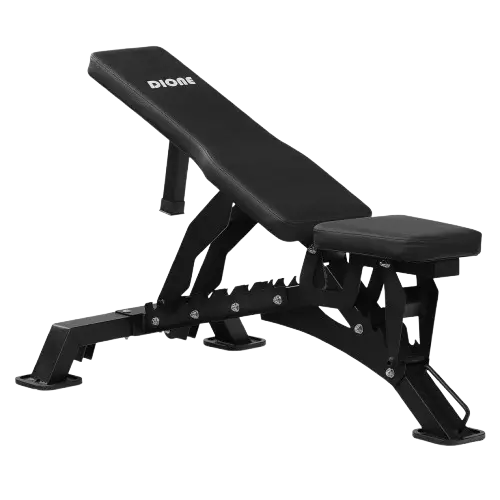
The bench press remains the ultimate strength test in the gym. Anyone looking to lift truly heavy seeks the limits of what is physically possible. Heavy weights require muscles of steel. However, they also demand an rock-solid foundation. A standard training bench often falls short once the kilos start piling up.
At StrayShop, we often see athletes investing in extra weight plates while their bench threatens to become their downfall. Choosing the right equipment is a matter of safety and performance. We are happy to explain what a bench must meet if you want to move serious weight.
Why a standard bench is insufficient for heavy lifting
Home athletes often start with a simple model. That is fine for light dumbbell exercises. As soon as you switch to a heavy barbell, the situation changes completely. A simple platform can start to wobble, bend, or in the worst-case scenario, break under maximum pressure.
Total load capacity = Athlete's body weight + Barbell weight
Someone who weighs 90 kilograms and wants to press 110 kilograms is already putting a 200-kilogram load on the structure. Many simple models are already at their absolute limit at that weight.
The danger of play and instability
An unstable surface immediately ruins your technique. Your body compensates for micro-movements by tensing small muscles. This energy belongs in the chest muscles and triceps. A wobbly surface causes reduced force production and increases the risk of injuries to the shoulders and wrists.
The impact of a flimsy construction
When steel bends, the position of your spine changes. You lose the necessary leg drive. Leg drive is the power you generate from the floor through your feet. Without a rigid structure, this power simply leaks away into the soft floor or the pliable frames.
The crucial role of load capacity and weight bearing
Anyone looking for the best weight bench for heavy bench pressing looks at the maximum load capacity first. This number indicates how much mass the bench can safely support. We always advise keeping a generous safety margin.
| User Type | Recommended Load Capacity | Construction Type |
|---|---|---|
| Beginner / Light use | Up to 200 kg | Light steel tubing (50x50 mm) |
| Intermediate lifter | 200 kg to 350 kg | Reinforced steel with wide base |
| Heavy lifter / Powerlifter | 350 kg to 500+ kg | Heavy duty steel (70x70 mm or more) |
Calculating maximum weight
The calculation example is simple but effective. Add your own body weight to the target weight you want to press in two years' time.
Example: 95 kg (body) + 155 kg (barbell) = 250 kg total load.
In this case, never choose a model that is tested exactly at 250 kilograms. Instead, go for a variant that is tested up to 350 kilograms or more. The dynamic forces generated when lowering the bar quickly place a much higher peak load on the frame.

Construction and material choice for maximum stability
The construction determines whether a frame stays as steady as a rock. Cheap benches use thin steel tubes with a minimal wall thickness. For heavy lifting, you need heavy, thick-walled box sections.
Important frame features
- Steel thickness: Choose box sections of at least 2 to 3 millimeters of thick steel.
- Profile size: A frame of 60x60 mm or 75x75 mm offers much more rigidity than a thin 50x50 mm profile.
- Weld quality: Continuous and neat welds distribute forces evenly over the entire construction.
- Width of the supports: A wide rear base prevents the bench from tipping if you move sideways.
At StrayShop, we select our strength equipment based on these strict construction standards. After all, we want you to be able to lie under that heavy bar with peace of mind.
Adjustable weight bench versus flat weight bench
One of the most important decisions is the choice between an adjustable variant (incline/decline) and a fixed flat variant (flat bench). Both options have unique characteristics for heavy workouts.
Fixed flat bench = Maximum rigidity + No moving parts
Adjustable bench = Versatility + Multiple angles for chest and shoulders
The benefits of a fixed flat bench
The classic flat bench remains the favorite of pure powerlifters.
- No hinges or moving parts that can wear out.
- Simple, solid frame with an extremely high load capacity.
- Often more affordable to purchase at a comparable steel quality.
- Offers a completely flat support without an annoying gap between the seat and the backrest.
The power of an adjustable weight bench
Do you also want to perform incline pressing exercises, such as the incline bench press? Then an adjustable model is indispensable. Pay close attention to the adjustment mechanism of an adjustable weight bench.
Pop-pin systems or sturdy ladder systems are the standard here. A ladder system allows you to change positions quickly and can handle enormous vertical forces without the locking mechanism slipping.
The pad: Thickness, density, and upholstery
The pad is strangely often forgotten when comparing specifications. Soft padding feels comfortable at first, but is disastrous for heavy bench pressing.
Always a firm padding
If you sink into the pad with a heavy weight, you lose the support for your shoulder blades. You sink into the foam, making the joint unstable. A high-quality bench uses a high-density foam filling. This barely gives way under pressure.
The right upholstery and grip
Slipping while setting up your arch is a common problem. Good upholstery has the following features:
- Anti-slip finish: Prevents your shoulders from sliding during tensioning.
- Durable material: Synthetic leather with double stitching does not tear easily at the corners.
- Moisture resistance: Easy to clean after an intense training session.
Dimensions and ergonomics according to international standards
Anyone who trains seriously wants to train according to the right measurements. The International Powerlifting Federation (IPF) uses specific dimensions for competition equipment. These sizes ensure optimal ergonomics and power transfer.
Important dimensions to look out for
- Height from the floor: Ideally between 42 cm and 45 cm. If the bench is too high, you cannot place your feet flat on the floor for a powerful leg drive.
- Width of the backrest: Between 28 cm and 32 cm. A backrest that is too narrow provides too little support for the shoulders. A backrest that is too wide hinders the free movement of the shoulder blades.
- Length of the backrest: At least 120 cm, so that the head and hips are always fully supported.
Handy features for the home gym
Heavy equipment is sturdy, but can also be bulky. If you are setting up a training space at home, smart extras are very welcome.
Transport wheels and handle
A high-quality adjustable weight bench for heavy use can easily weigh between 30 and 50 kilograms. Integrated transport wheels and a sturdy handle make moving it easy. You can roll the frame out of the way or into a squat rack when you are done.
Space-saving folding?
Some athletes are looking for a foldable weight bench. Although foldable models are handy for small spaces, they almost always compromise on absolute rigidity. The hinges required for folding eventually become weak points. For extremely heavy bench pressing, we almost always recommend a fixed or heavy adjustable frame without a folding mechanism.
Safety during bench pressing
Heavy lifting without a spotter entails risks. Your bench is only one part of a safe platform.
Combine with a Squat Rack or Power Rack
You almost always use a separate bench in combination with an independently adjustable rack or inside a power rack. Ensure that the leg construction of the bench does not interfere with the uprights of the rack. T-legs or a three-point design at the front ensure that you can place your feet freely without tripping over the steel frame.
Use of safety spotter arms
If you are training without a partner, catchers or safety arms are necessary. Should a repetition fail, these steel arms catch the weight before it hits your chest.
Practical tips for maintaining your equipment
A good investment will last a lifetime with proper care. Heavy use does require periodic maintenance.
Maintenance checklist
- Check bolt connections: Tighten all bolts and nuts once a month. Vibrations can cause connections to slowly loosen.
- Clean pad: Wipe down the upholstery after every workout with a damp cloth and mild soap. Sweat will eventually damage the material.
- Lubricate hinges: Apply a drop of silicone spray to the pivot points of an adjustable model to keep it adjusting smoothly.
Make the right choice for your goals
Choosing the right equipment is an investment in your own safety and progress. Do not let your decision depend solely on a nice offer. Look critically at the steel box section, the total weight the frame can handle, and the firmness of the pads.
At StrayShop, we help strength athletes every day with selecting equipment that can withstand the toughest workouts. Determine where your limits lie, choose a frame that is built well above that limit, and focus one hundred percent on breaking your personal records.
Conclusion: Build a safe and rock-solid foundation
Bench pressing with heavy weights leaves no room for doubt. The right surface forms the bridge between a successful lift and a dangerous situation. By choosing a frame with a high load capacity, thick steel box sections, and firm, anti-slip upholstery, you lay the foundation for long-term progress.
Whether the preference is for a sleek flat variant or a versatile adjustable weight bench, safety and stability always come first. Those who invest in quality train with more self-confidence and get the most out of every repetition. View the complete assortment on the StrayShop website and choose the equipment that effortlessly supports your strength goals.
Read More :
How to choose an adjustable training bench based on seating position and training angles?
How much weight do you need in a power station if you want to get stronger?